Woodland Reverie
An Artist Talk
It seems as we move through our lives a quiet osmosis is taking place, a persistent absorbing of information through our experiences that forms our memories and informs our perception of the world. This happens whether we are aware of it or not, whether we are artists or bankers or mothers or children.
In his 2025 Italian fashion week speech, Christian Leon said “artists are not entertainers, they are explorers of our inner landscape, they descend into the turbulence of being, so that we can recognize ourselves again. They turn fragility into form.” In this artist talk I attempt to form a picture of the inner landscape I was exploring when I painted the works in this show.
We must go back to 2019, shortly before our global descent into isolation, where I found myself already quite isolated. My family and I were moving to the UK for my husband’s PhD at the University of Cambridge. I found myself standing in the airport, all our possessions in suitcases, two young children in my arms and an unmistakable premonition that this was a significant goodbye between my father and me. A few months after arriving in the UK, we received the disappointing news that my dad had a terminal brain tumour. And then the pandemic hit. Because of travel restrictions it was difficult to make it back in time to see him, but I was fortunate to have three days with him before he died. Not everyone gets that chance for a goodbye and I’m grateful. That time of isolation before and after my dad’s death was a time of significant reorganization. An unravelling or detangling of myself, requiring me to examine the forgotten closets of my person, whether I was prepared to or not.
A few things became apparent: I had grown up preoccupied with being good. A goodness that performed all the required tasks to keep the peace for my family and my social circles. There were many reasons for that. One of which was simply my own personality propensities. I was an avoider of conflict and a pleaser of people. Another reason was a childhood faith that was heavy handed in motivating fealty with shame. I recognized early on I had this personal power to bring a sort of peace, or at least a diplomacy, into relationships that were otherwise tense. Though too young to form the much-needed boundaries for this work, I quickly internalized other people’s disorganized emotions to neutralize situations. After practising this throughout my impressionable years, I became disembodied and disassociated from my own hopes and desires.
So there I was, an ocean away from all I had known. My old world was drying up like sand and there was no stopping it from falling through my fingers. But when the tide was highest my favourite poet, Mary Oliver, slipped into the fray to save my life when I read her poem “Wild Geese.” Her poem set a new course to navigate the turbulence. It goes like this:
You do not have to be good.
You do not have to walk on your knees
for a hundred miles through the desert repenting.
You only have to let the soft animal of your body
love what it loves.
Tell me about despair, yours, and I’ll tell you mine.
Meanwhile the world goes on.
Meanwhile the sun and the clear pebbles of the rain
are moving across the landscapes,
over the prairies and the deep trees,
the mountains and the rivers.
Meanwhile the wild geese, high in the clean blue air,
are heading home again.
Whoever you are, no matter how lonely,
the world offers itself to your imagination,
calls to you like the wild geese, harsh and exciting—
over and over announcing your place
in the family of things.
At nearly thirty years old, I began to discover, for the first time, where I fit in the world and how to inhabit that space. This was my inner landscape.
While on a walk in the picturesque landscapes of the Cambridge countryside, the first little animal painting appeared fully formed in my mind. It was as if something deeply buried in the layered sediment of my subconscious was uncovered. The picture was the mother mallard. (Featured in the show as one of the printed greeting cards.) Her kerchief and the curve of her beak and the powder blue border were all fully imagined before I began to paint. Very soon after came the bunnies and the mice and the fox and the swan and the heron and the fish and the badger, until I had about twenty little animal paintings. I taped them up in the kitchen of our cramped student-housing flat to decorate the blank wall. It was not long before the social restrictions lifted and I went back to work, and my art focus shifted to painting more abstracts with oil and interior design.
When I moved back to Canada last August and met with Kathryn at Bright & Brine, she asked if I would be willing to create more of these little animals for a 2025 Christmas show. I was delighted by the opportunity for my first exhibit. As I began to envision what to create, I found my new self revisiting my old self. As the opening drew nearer, I started to feel that unmistakable unease of embarrassment in my stomach. Surely this work was too wholesome, too simple, too childlike. It wasn’t saying enough, it wasn’t provocative enough, it wasn’t helping anyone. How could I ask for people to spend the resource of their attention on this? I also wondered if it was honest enough. Did this work still represent me or was this my old hat?
I realized that, of course, this embarrassment wasn’t about the work but rather about the old self I had set aside. It was exposing the gap of who I was and who I thought I should be. And I was feeling the vulnerability of letting this old self be seen.
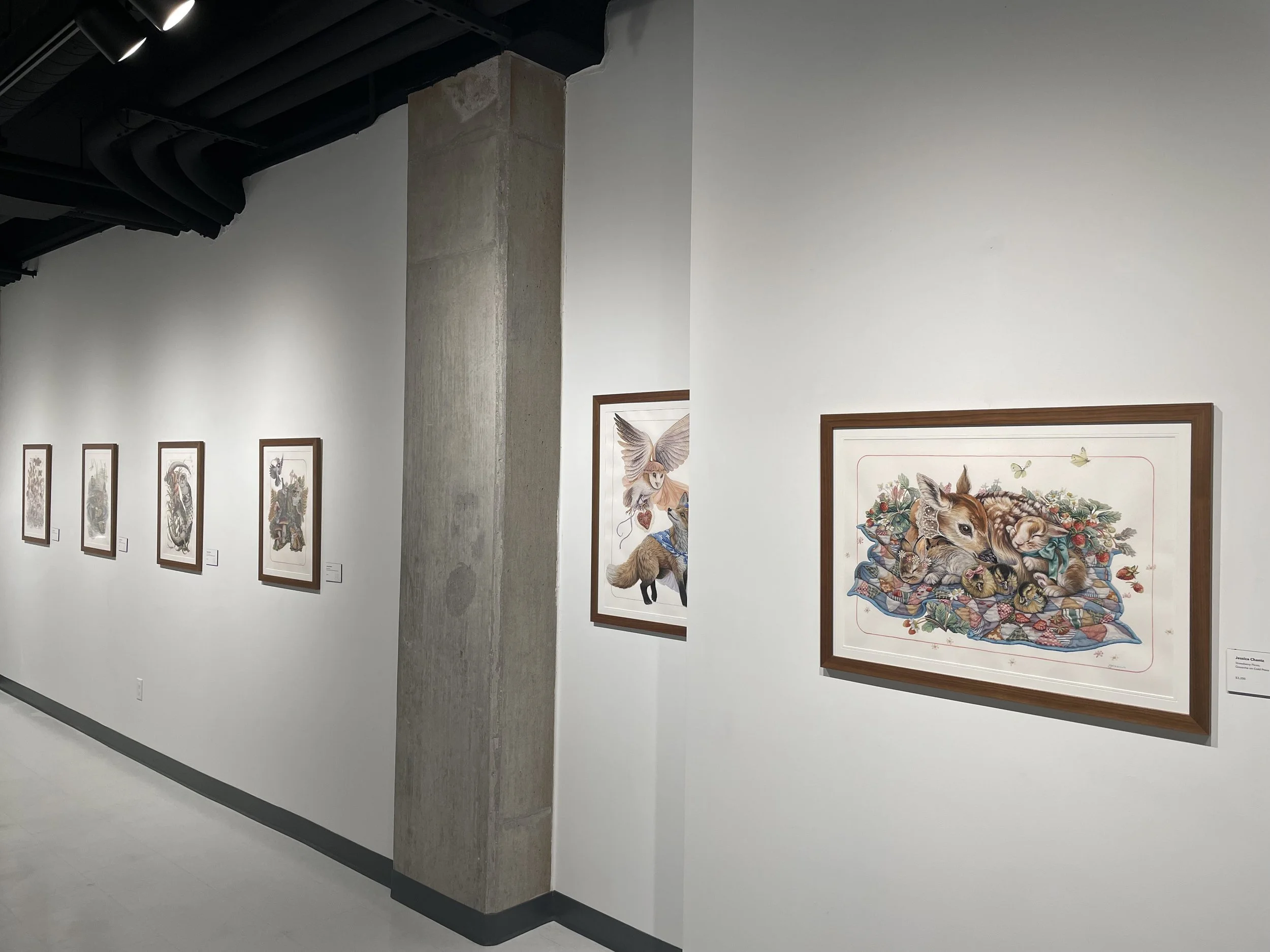
But as I looked back at that isolated woman, who identified with the smallness and fragility of these little creatures, I came to see these animals acting as doorways back to that softness I thought I needed to leave behind to be more grown up, to be more artistically relevant. The geese painting, “Home Again,” was created with Oliver’s poem in mind—about that permission for all the selves to be welcome and present and open and soft and at home, to find a solace in belonging. So the truth I didn’t expect was that my “artist voice” wasn’t informing my work’s direction but rather my work was teaching me that the beauty within, in whatever form, is worth being seen.
As to why I use gouache, we must go back even further to the midcentury. I have a love for the art, illustration, and design of the 50s and 60s. I grew up enamoured by the visual language of midcentury artists like Mary Blair and Eyvind Earle, who illustrated with Disney, and Maurice Noble, who is well known for his Looney Tunes backgrounds. They didn’t just decorate stories, they captured the magic of the imagination. Their work is a perfect example of how simplicity and childlike wonder can be sophisticated. These illustrating Greats used gouache most often, as did many illustrators and animators of that era. I fell in love with gouache’s versatility. The way it can mimic the opacity of thicker mediums or the wash of watercolour. It reactivates when wet, which I learned to use to my advantage when creating fur or feather-like textures. But it can be tricky at times, particularly when trying to balance dramatic shade variations like black and white as they keep mixing.
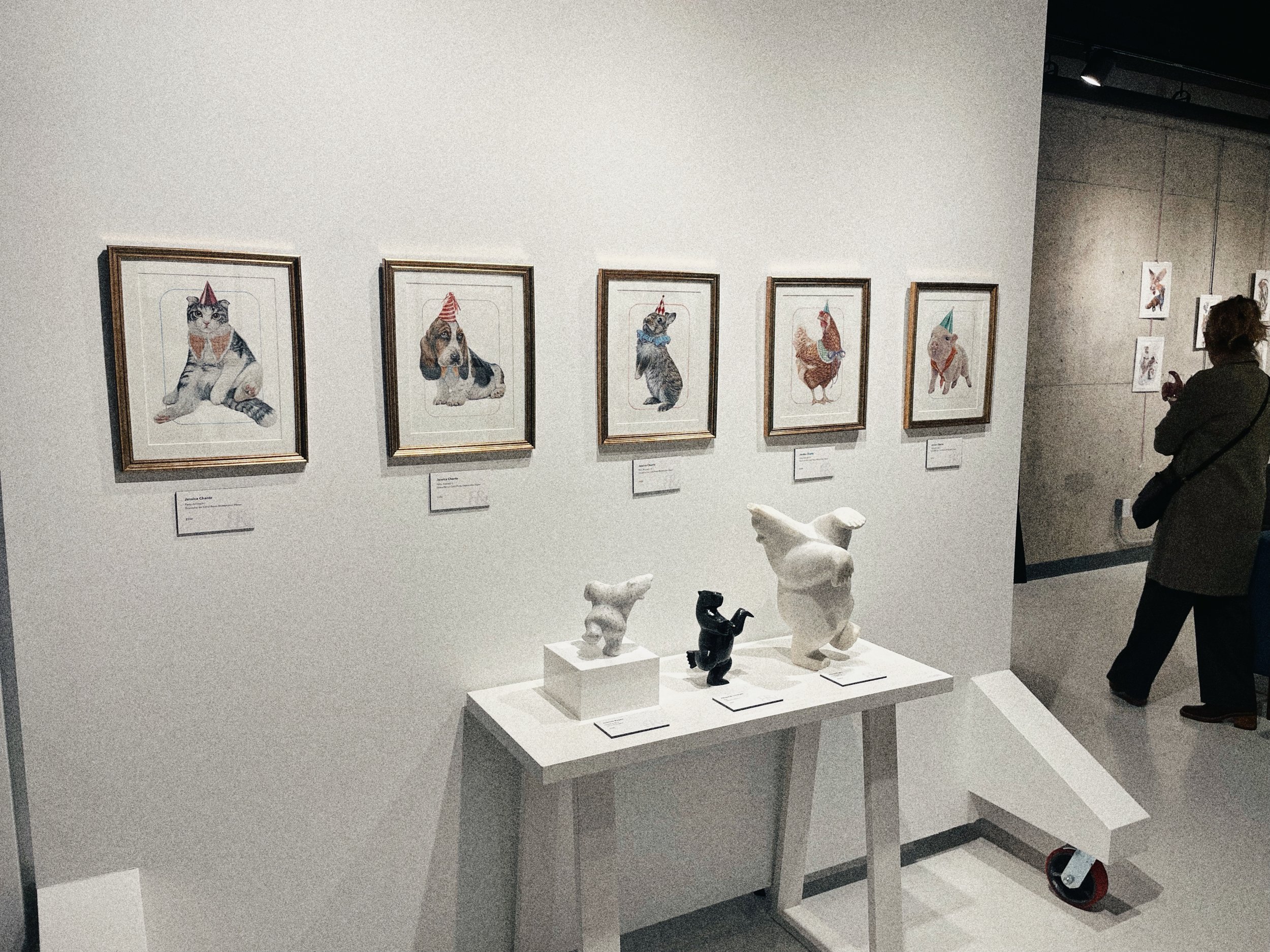
For my routine in creating the new works in this show, I would select animals based on creatures that could be found locally in New Brunswick. Then I would sketch with pen or pencil how the animals might fit together to feel balanced on a page. Some of the activities of the animals in the paintings are based loosely on the animals’ natural instincts, like the playfulness of a fox or the homeward flight of a goose. Next I would find reference photos. Since I didn’t venture out into the wilderness to find the creatures myself, I relied on using other people’s photos. I seek to select photos that aren’t professional as to maintain an integrity of workmanship and also to emphasize that a passing photo of geese flying home, captured casually on someone’s phone, is still brimming with beauty and wonder.
I didn’t manipulate the faces or forms of the animals very much, besides adding the little hats and things they wear. Perhaps a slight upturn at the corner of the mouth or an extra glint in the eye, but otherwise they are left as they are with their real life expressions of curiosity and gentleness and mischief. But putting clothing on them isn’t the only element that anthropomorphizes them. The clothes are there to help redirect our attention to reveal something that is already present—the dignity of emotion and soulfulness that we share, a mirror for our own courage, playfulness, and curiosity. It reminds us to pay attention to our inner and outer landscapes.
As I worked on this series, I’ve come to understand that I no longer need my art to deliver answers. Which comes as a relief. Instead of moving forward with some sort of artist thesis, the act of creating is its own form of inquiry and exploration. As Oliver says in another poem, “I love this world, but not for its answers.” So this show, with these small creatures, is an invitation to have that precious and delicate conversation with wonder and delight. Our world is speaking to us constantly, coaxing us to let the soft animal of our body love what it loves.